
How AI Detects Manga Speech Bubbles: Computer Vision & Bubble Masking Explained
Learn how computer vision isolates manga speech balloons. Deep dive into YOLO segmentation, polygon boundary masks, tail tracing, and off-bubble whispers.
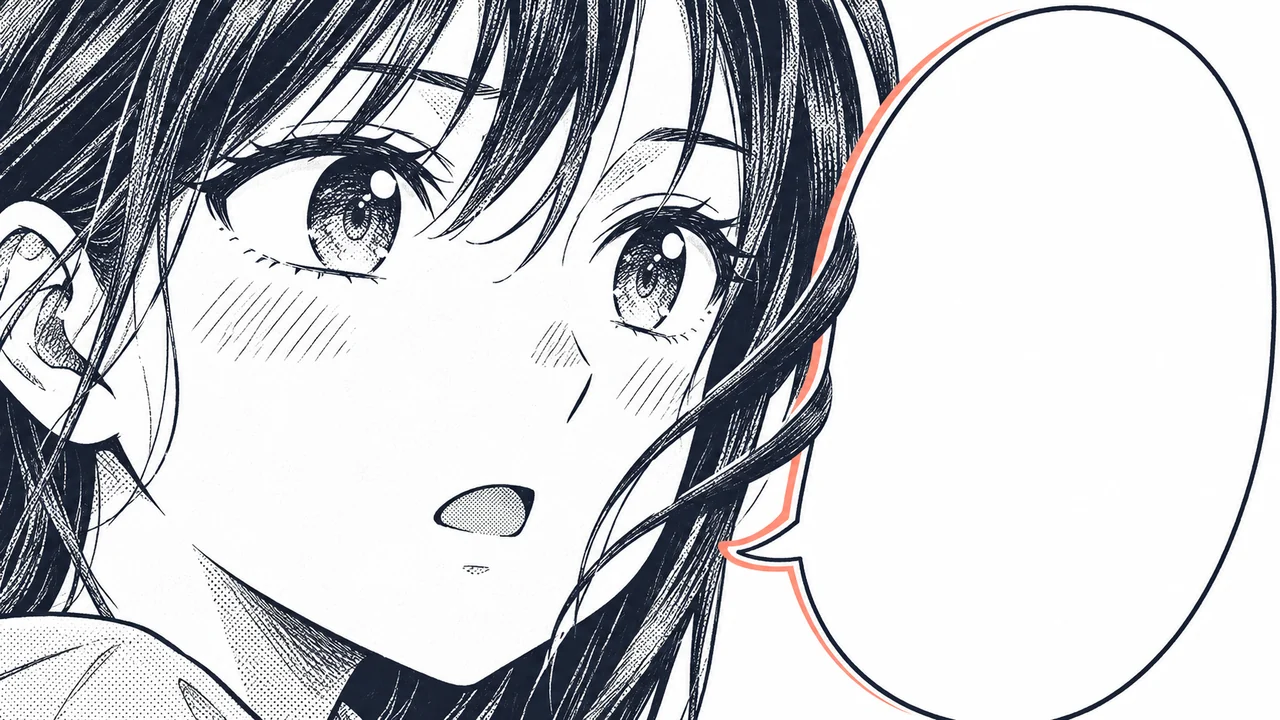
In the visual storytelling of manga, speech balloons are far more than containers for text—they are emotional instruments. A smooth rounded oval conveys calm narration, an explosive spiky starburst signals a battle cry, and an undulating cloud balloon represents a secret inner thought.
For an automated comic translation system, correctly detecting and masking these bubbles is the foundational first step. A single detection error cascades down the entire pipeline: miss a bubble, and you leave Japanese text untranslated; overestimate a bubble boundary, and you accidentally erase a character's face.
Here is how modern computer vision solves speech balloon segmentation.
The Diversity of Manga Balloon Anatomy
Unlike Western comic books that rely on fairly uniform rounded rectangular balloons, Japanese manga and Korean manhwa employ an extensive taxonomy of visual dialogue containers:
Manga Speech Balloon Anatomy
- Normal speech uses an oval balloon. The tail points to the speaker.
- Shouting uses a burst with sharp points.
- Inner thoughts use a rounded thought balloon.
- Regular Elliptical Balloons: Smooth, continuous stroke contours.
- Explosive Shout / Spiky Balloons: High-frequency sharp vertices, often overlapping panel gutters.
- Cloud & Soft Thought Balloons: Dotted, dashed, or undulating curved outlines.
- Border-less Rectangular Narration Boxes: Often transparent or semi-shaded with vertical dividers.
- Direct Overlay Text (Whispers / Tsukkomi): Raw handwritten text scribbled directly on screentone art with zero enclosing border.
The Computer Vision Challenge: Tails, Hair, and Panel Gutters
Why can't simple edge detection (like Canny or Hough transforms) find manga bubbles?
- Character Occlusion: Characters frequently lean over bubbles, overlapping speech borders with detailed hair strands or sword blades.
- Speech Balloon Tails: Tails extend toward a speaker's mouth. Erasing the tail ruins the visual link of who is speaking.
- Open-Ended Balloons: Mangaka frequently leave the bottom or side of a balloon open, allowing speech to blend into the white margin of the panel gutter.
Modern Detection Architecture: Semantic Instance Segmentation
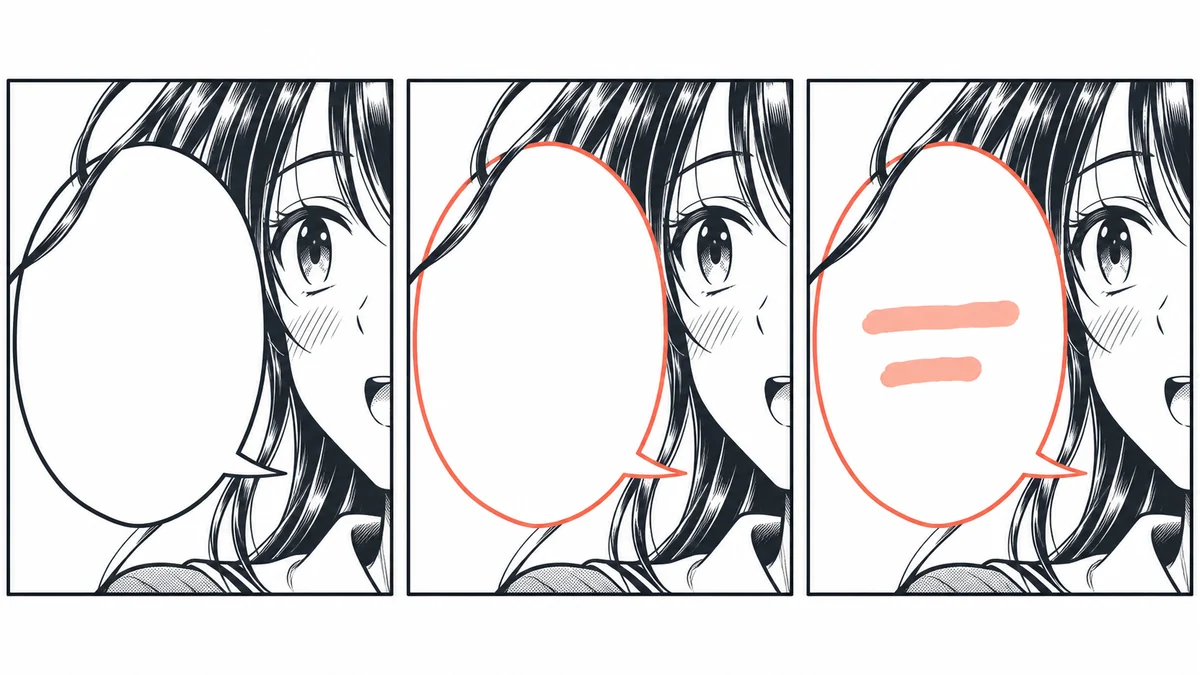
State-of-the-art manga translators rely on deep convolutional and transformer-based instance segmentation (such as specialized variants of YOLOv8-Seg, Mask R-CNN, and SegFormer).
Detection Pipeline
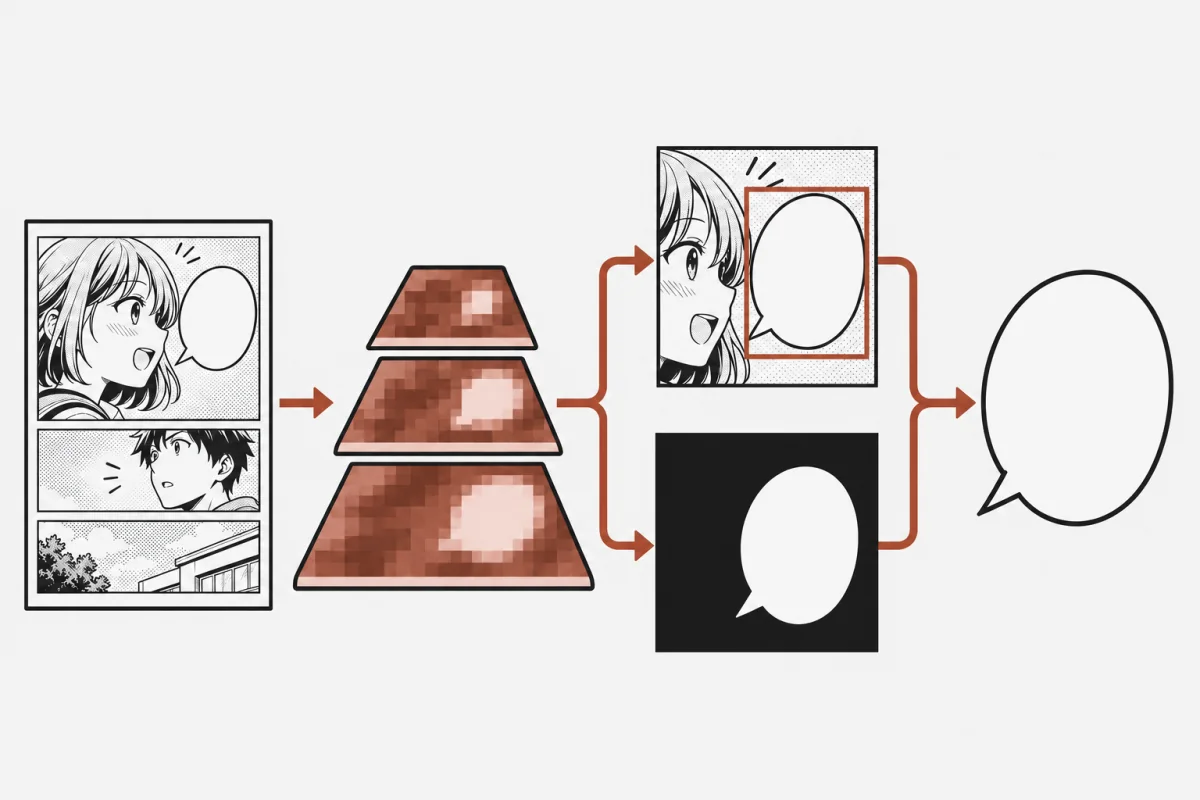
- Raw Manga Page
- Feature Pyramid Network (FPN). Extracts multi-scale visual features.
- Parallel prediction.
- The Bounding Box Head predicts the bubble class and box.
- The Mask Prototype Head computes pixel-level mask prototypes.
- Polygon Boundary Synthesis. Produces an accurate contour excluding tails and hair.
1. Multi-Scale Feature Extraction
Manga pages feature balloons ranging from gigantic two-page scream bursts to microscopic side comments. Feature Pyramid Networks (FPN) ensure that small whisper crops receive equal detection sensitivity as dominant dialogue boxes.
2. Tail Tracing & Protection
The neural model is explicitly trained to segment balloon bodies and balloon tails as distinct sub-classes. When sending the mask to the inpainting and typesetting engines, the system protects the tail's directional vector while only clearing the interior chamber where text resides.
3. Whispers & Off-Bubble Text Identification
For handwritten quips drawn without enclosing frames, the detector uses localized character stroke density clustering. Instead of expecting a white circle, it identifies high-contrast ink stroke clusters sitting on screentone backgrounds.
From Detection to Inpainting: Generating the Perfect Mask
Once a balloon is detected, the system creates a high-precision binary mask for the inpainting step:
- Raw Bounding Box. Contains the speech bubble and its dialogue, such as 「こんにちは!」.
- Character Stroke Mask. Keeps only the text strokes.
- Dilated Inpaint Mask. Expands the masked strokes by 2–3 pixels.
- Text Binarization: Isolates the exact ink stroke pixels of the Japanese characters.
- Adaptive Dilation: Expands the stroke mask by 2 to 3 pixels outward to catch antialiased boundary artifacts, ensuring no faint shadow of the original Japanese text remains visible after inpainting.
This precision is why AI Manga Translator produces scanlation-grade pages without blurry artifacts or missing dialogue.
References & Authoritative Sources
- IEEE Computer Society / CVF — Segment Anything & Mask R-CNN: Instance Segmentation for Non-convex Comic Shapes
- Tokyo University Manga109 Project — Manga Speech Bubble Detection Benchmark
- IEEE TPAMI — Transactions on Pattern Analysis and Machine Intelligence: Comic Page Understanding