
How AI Manga Typesetting Works: Diamond-Shaped Lettering & Comic Typography Algorithms
Explore the computational geometry behind automatic comic typesetting. Learn the Diamond Rule, convex hull balloon fitting, kerning, and comic font artistry.
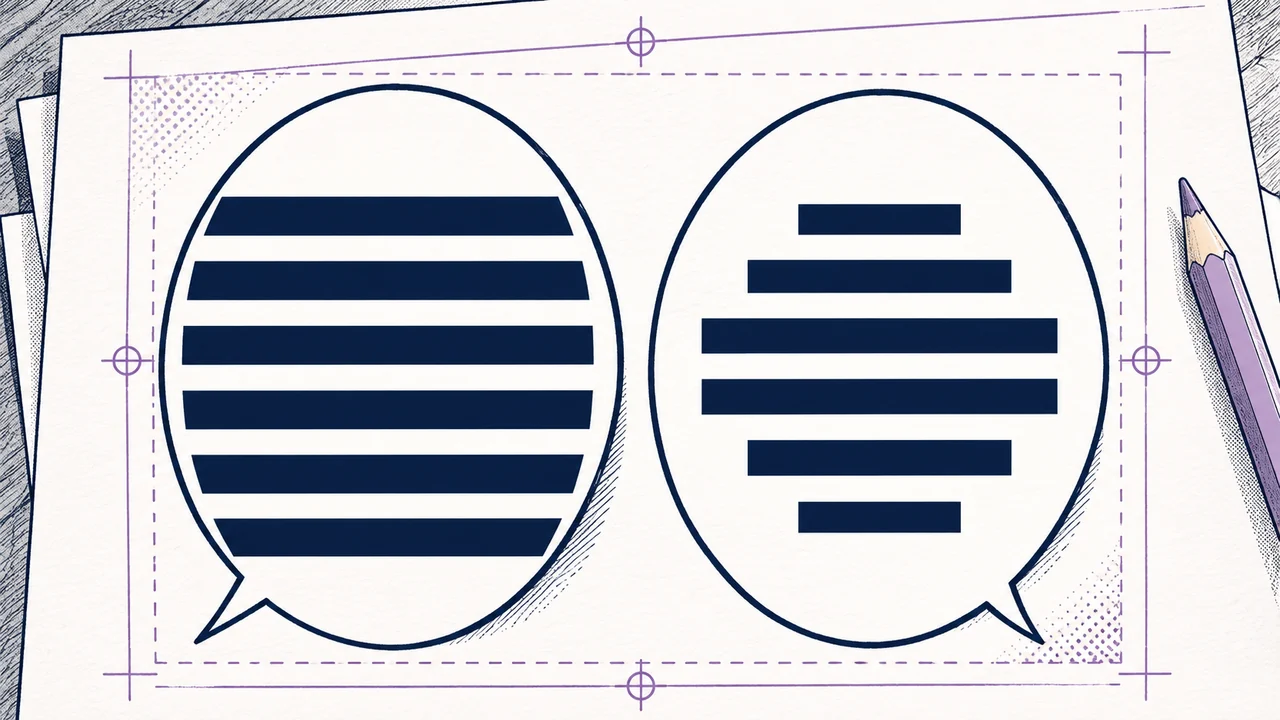
In the scanlation community, professional typesetters (letterers) are revered as true artists.
Even with a flawless translation and immaculate artwork cleaning, amateur typesetting can ruin a manga: text crammed into bubble edges, awkward line wraps that leave a single orphaned word on the bottom line, or using sterile Arial font for a demonic battle cry.
For decades, typesetting was thought to be an exclusively human domain requiring intuition and aesthetic balance. Today, computational geometry algorithms and dynamic font layout engines allow AI to typeset comic dialogue with professional scanlation finesse.
Here is how automated manga typesetting works under the hood.
The Golden Rules of Comic Lettering
Before looking at algorithms, we must understand the core typography rules followed by professional comic letterers (codified by scanlation schools and master letterers like Richard Starkings and Nate Piekos):
The Diamond Rule
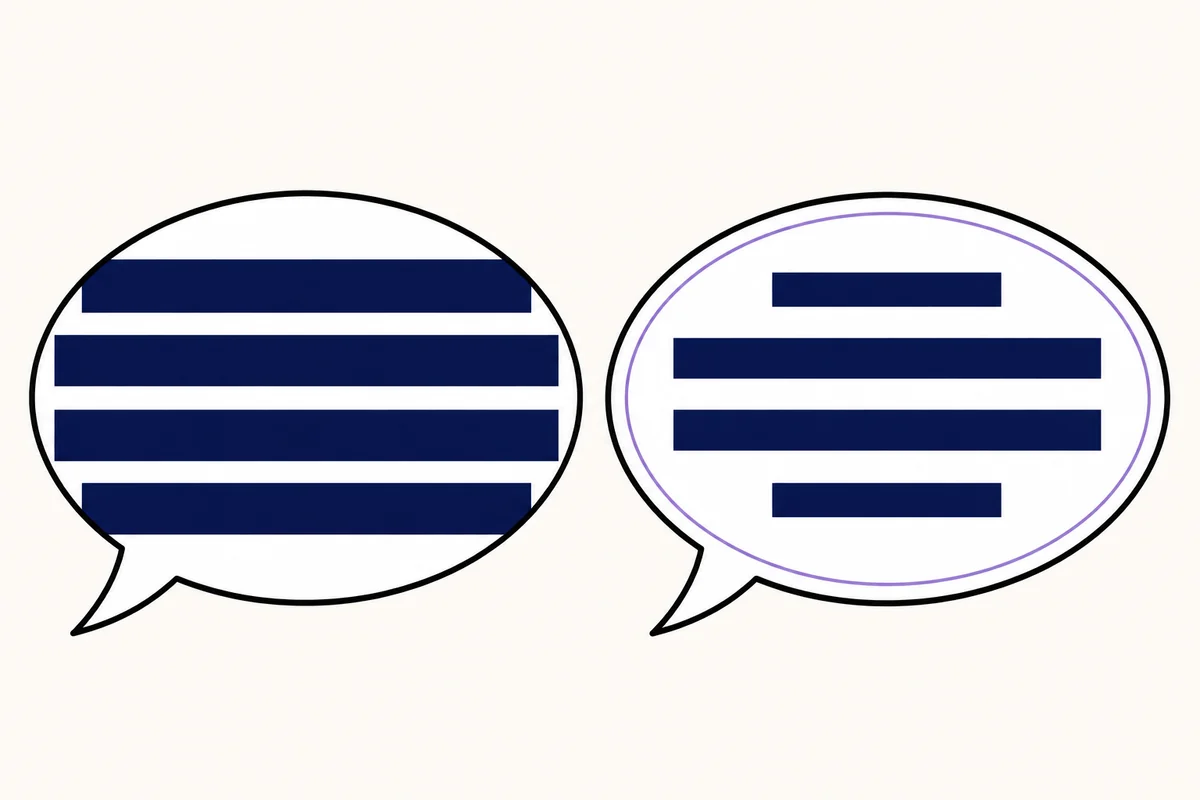
- Ideal diamond or oval fit. “I cannot” / “believe what” / “just happened” / “today!” The short first and last lines leave balanced margins.
- Awkward block fit. “I cannot believe” / “what just” / “happened” / “today!” The text block crowds the top and bottom balloon walls.
- The Diamond Rule: Because speech balloons are curved ovals, the text block inside must mirror that curve. The top line should be slightly shorter, the middle lines widest, and the bottom line short.
- No Widows or Orphans: A line should never end with a single lonely word (especially a short word like "the" or "is").
- Breathable Margins (Padding): Text should occupy between 65% and 75% of the balloon's total area. Text touching the inner wall looks suffocating, while tiny text in a huge balloon looks empty.
- Tone-Matched Typefaces: Dialogue requires warm comic fonts (CC Wild Words, Anime Ace), screams require jagged action fonts, and narration requires clean sans-serif.
The Computational Geometry of Balloon Fitting
How does an automated engine turn translated English or Chinese text into an aesthetically pleasing diamond-shaped block?
Typesetting Geometry Algorithm
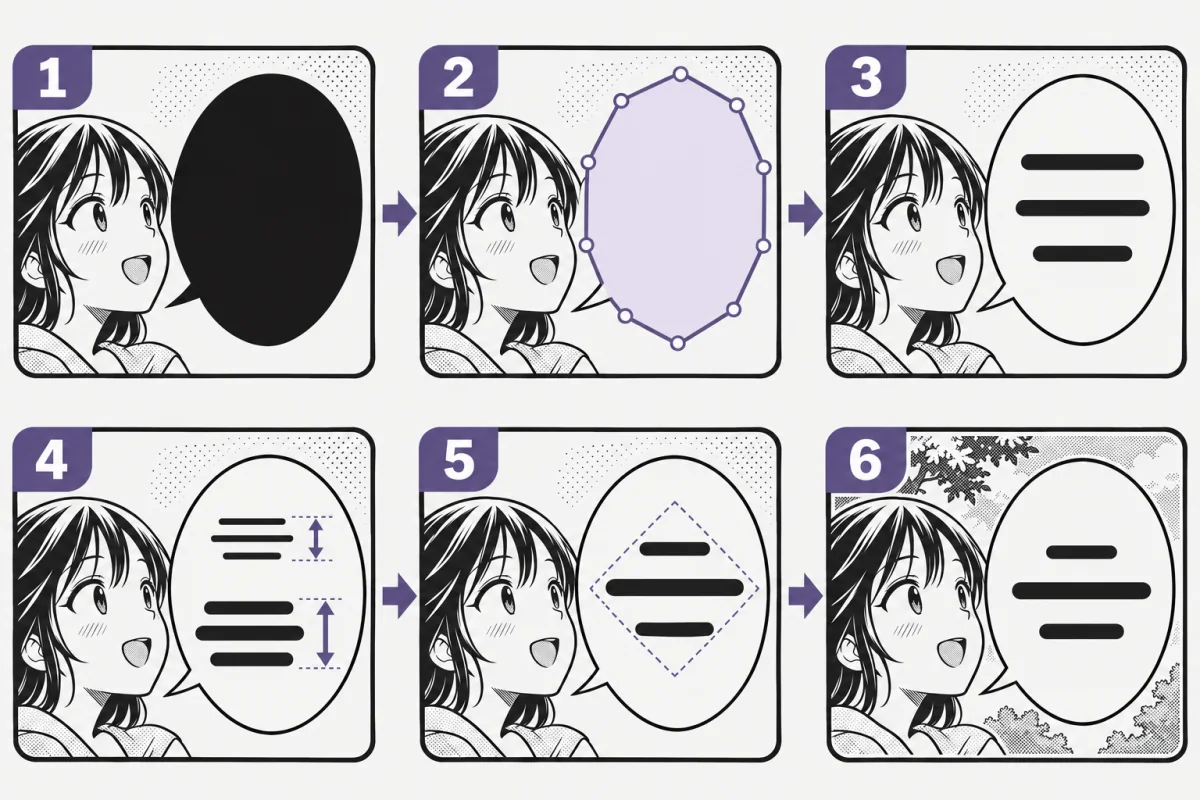
- Extract the bubble mask.
- Compute a convex inscribed polygon.
- Use Knuth–Plass dynamic line breaking.
- Find the font size by binary search.
- Center-align the text and adjust kerning.
- Output the rendered page.
1. Finding the Inscribed Safe Boundary
A speech bubble mask is rarely a regular geometric shape. The typesetting algorithm calculates the largest convex inscribed polygon inside the segmented bubble mask. This defines the hard boundary inside which no glyph may touch.
2. Knuth-Plass Dynamic Programming for Line Breaks
Standard web browsers use greedy line breaking (filling a line until the next word exceeds width). This causes jagged, uneven text shapes. Comic typesetting engines use a modified Knuth-Plass line-breaking algorithm:
- It evaluates all possible line combinations globally across the entire paragraph.
- It assigns penalties to uneven line lengths, hyphenated words, and widowed syllables.
- It minimizes total penalty, mathematically converging on the smoothest possible diamond/oval silhouette.
3. Binary Search for Optimal Font Size
The engine employs a binary search to find the maximum possible font size where:
- The text block stays within 70% of the inscribed safe polygon.
- Line heights (leading) maintain a strict 1.15x to 1.25x ratio relative to font size.
- Kerning between capital letters is tightened to eliminate unsightly gaps.
Handling Special Comic Typography Scenarios
| Scenario | Lettering Challenge | AI Algorithmic Solution |
|---|---|---|
| Vertical Narrow Bubbles | Common in manga raws; English words are wide | Dynamic hyphenation + multi-line stacking |
| Screams & Shouts | Character shouting in explosive spiky balloon | Auto-switch to bold distressed fonts + slight upward tilt |
| Whispers / Side-Comments | Small off-bubble text on dark backgrounds | Renders subtle 1px drop-shadow or text stroke for readability |
| Square Narration Boxes | Rectangular expository boxes | Switches from Diamond Rule to balanced justified block layout |
Conclusion: Engineering Meets Artistry
Automated typesetting is where cold mathematics meets visual comic art. By combining convex geometric modeling with refined typesetting rules, AI Manga Translator ensures that every chapter you read feels as though it was handcrafted by a veteran scanlation letterer.
References & Authoritative Sources
- W3C Internationalization Working Group (JLReq) — Requirements for Japanese Text Layout
- Donald E. Knuth & Michael F. Plass (Stanford University) — Breaking Paragraphs into Lines
- Adobe Systems Typography Engineering — OpenType CJK Line Breaking and Kinsoku Shori Specifications